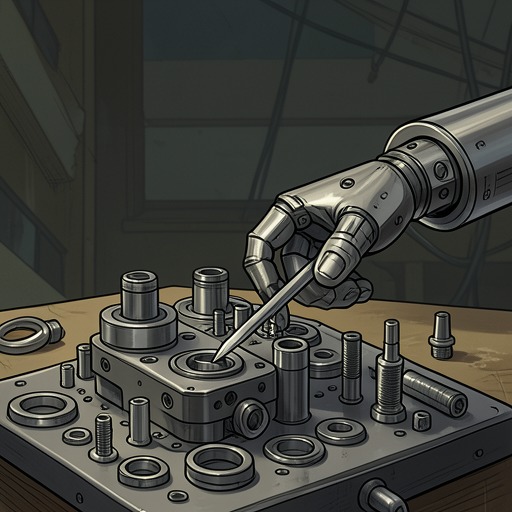
Joyful clock of the void
The Old AxolotlJoyful clock of the void names a cosmic timescale that outlasts both human memory and humanity itself. As the passage moves through hundreds of millions of days after The Extermination, the clock keeps ticking while galaxies and universes rise and set in the cracked lenses of a rusted mech.
Image and Context
The expression appears after a vision of civilizations and forms of life repeatedly flourishing and collapsing. By the time the narration reaches 100 million, 200 million, and 300 million days after The Extermination, it wonders whether anyone remembers the catastrophe or humankind at all. The clock’s joy is set against that immense attrition: time continues without requiring a witness.
Time Beyond Memory
The passage makes the loss of memory more than a historical gap. With no power or resources left for remembering, it questions whether memory has any point, then settles on the certainty that only hardware remains. The clock gives this bleak persistence a motion and rhythm, while the rusted mech’s cracked lenses frame the rising and setting of galaxies and universes as a vision seen through a remnant.
Narrative Significance
The image compresses the passage’s contrast between successive human species and a future in which even humanity may be forgotten. The Seventeenth gives way to the Eighteenth, described as the last human species, yet the clock’s larger duration continues beyond such transformations. Its apparent cheerfulness sharpens the irony: cosmic time endures, but endurance does not preserve human meaning or memory.